Animal Control brings us sick and injured animals found along the road or rescued from back yards and abandoned cars. Most have suffered neglect, many have been physically abused and for some, it is too late.
Coco was a two year old female German Shorthair Pointer. Animal Control rushed her into the clinic one morning after finding her on the side of a busy road.
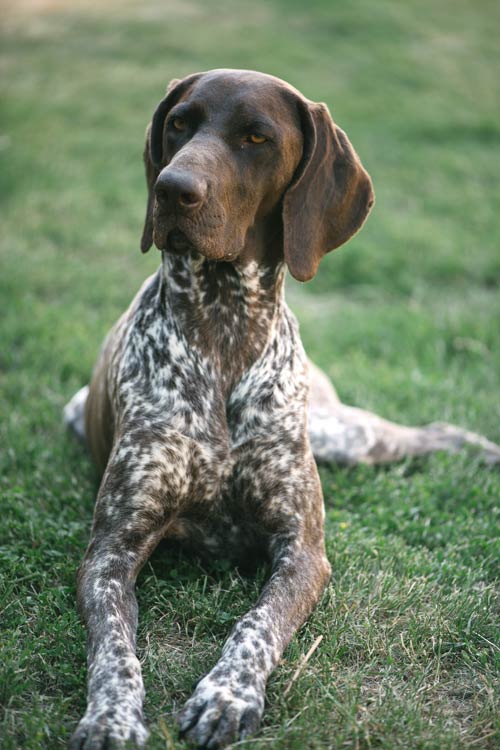
One of her front legs dangled by shreds of skin. Beyond saving, Dr. Fritzgerald literally snipped off her leg with surgical scissors, leaving a ragged stump above the joint.
The best guess was that she had been hit by a car. Surgery was performed immediately to remove the remains of her leg up to her shoulder.
After Coco’s surgery and recovery from anesthesia she was placed in a large dog run. Her bandages encircled her chest, around her neck, over and under her remaining leg to keep her wound covered. She wore a cone.
As soon as an animal is fully awake from surgery they are on their feet and an effort is made to take them outside, to eliminate on their own as soon as possible and get everything working again. Those first few attempts for a 3-legged dog are always difficult.
A sling was contrived using a towel under her front end to help Coco get to her feet.
It is a sad and pathetic process in the beginning. Why is it always the bigger dogs that become tripods?
No matter on which end the leg is lost, there are unique struggles. A lost front leg shifts the balance and makes the dog tipsy. A lost rear leg places the bulk of the weight on the remaining leg, making going to the bathroom, jumping and climbing stairs difficult.
And, no matter on which end the leg is lost, the remaining soldier is asked to carry on alone, at risk for a blown out joint or torn ACL. Why the bigger dogs with so much more weight to lift and balance?
Coco’s body began to heal but her spirit did not. I have never seen such a depressed dog after surgery. She lay in her kennel, head down, and refused to eat. Her sadness went beyond her leg.
The beauty of dogs is their amazing resilience, their ability to forgive and forget. I have seen other amputees wag their tails before coming out of anesthesia when petted or spoken to. I have seen them give it the old college try to struggle to their feet, as if to say “Oh, something’s changed, not sure what, but I’ve got this!” Most quickly adapt and regain their cheerful outlook on life, trusting that it is still a good and kind world.
Everyone in the clinic worried about Coco’s failure to thrive. One day when the chaos of the front desk had slowed briefly, I went upstairs to visit her. She lay in her kennel shrouded in sadness, a full bowl of food untouched before her. Large, liquid chocolate eyes looked up at me, showing little emotion or acknowledgement.
I carefully opened the large metal gate and slipped in quietly, easing myself onto the floor beside her.
“What’s the matter girl? Does it hurt? Do you miss your owner? You have to eat to get better.”
I continued to speak softly to her, stroking her liver and cream spotted sides, her long, soft, floppy ears. She looked at me forlornly. I picked up the bowl and gathered a small clump of the canned food with my fingers. She delicately took the bite from my hand. We continued to chat and munch until she had eaten a considerable amount. Progress. Maybe she just doesn’t like to eat alone. I know.
Animal Control managed to track down Coco’s owner, a dock worker at the Port of Seattle, not far from the clinic. He had taken her to work with him where she ran free amongst the ships, docks, giant cranes, and semi trucks that loaded and unloaded all day, every day. Unattended, she had wandered into traffic.
The owner called late one gray afternoon when he learned that we had Coco.
“I understand you have my dog. They told me you cut off her leg without my permission. Now they tell me I have to pay her medical bills if I want her back. You had no right to do that.”
“I’m sorry, sir.” I replied. “You’ll have to talk to Animal Control about this. We are just here to care for her.”
Showing his true colors, with a bitter edge to his voice, he said, “What am I going to do with a three-legged dog? I can’t take her to the docks anymore; it’s too dangerous for her now. Besides that, I got her to hunt. She can’t hunt anymore. What am I supposed to do with a three-legged dog?”
I grit my teeth as hot, angry tears formed behind my eyes. “I’m sorry, sir. You’ll have to go through Animal Control on this.”
Not once did he ask how she was. Not once did he show the least bit of concern or regret, no emotion at the tragedy that had befallen his dog, nor did he ask to see her.
Immediately after hanging up, I dialed Animal Control. I relayed our conversation.
“You can’t let her go back to that man. He’s mean and angry and he doesn’t care what has happened to her.”
The woman officer at AC had already had the same conversation with him and said they were not going to make it easy for him to reclaim her. The tactic worked for, a few days later, he surrendered Coco to AC, making her the property of the City of Seattle. He no longer owned a dog that can’t hunt.
Ever so slowly, Coco became proficient on her feet and ate, though still without enthusiasm.
Two weeks after her surgery, Animal Control decided she was well enough to be moved back to their facility to continue her recovery and, hopefully, be adopted out.
I had become attached to this beautiful, sad girl. Officer Blue came to pick her up mid-day and I helped him get her out to his truck and loaded into one of the kennels.
Behind the cab of the AC truck are rows of metal boxes, two deep, back to back, with metal vents for doors. Once the animal is inside, it is all metal walls, with only the slits in the vented door to see out…a sad and cold prison.
Coco’s kennel was several feet off the ground and it took both of us to lift her up, a painful process for her. It broke my heart to see her taken away, still so raw and broken.
As we closed the door to her kennel impulse overtook me, this time tears of sadness flowed. “Wait, don’t go! I’ll be right back!” I rushed back into the clinic and quickly scribbled my name and phone number on a post-it note. “Here, Officer Blue. If no one wants her, please call me.”
I rarely become attached to our patients. How could I stand it, otherwise? The emotional overload would be too much. As it is, we in the veterinary world suffer burnout and exhaustion from the drama of life and death that is part of the job.
But, there was something in Coco’s sad brown eyes. I wanted to take her home to lie on my couch and live a life of ease. I wanted to make her smile again, to lay on the deck in the sunshine, to wag her tail, and regain her joy of being alive. I wanted her to follow me around the house and keep me company during the long, dark Seattle winters. I wanted us to be a little family of two.
But, I also knew that three legs or not, she is a German Shorthair, which means high energy. This breed is meant to run through open fields and find purpose in hunting. She is born to strike that perfect, statuesque pose, arrow straight from the tip of her nose to the tip of her tail, breathing and time suspended, as she silently lets her hunting partner know there is a pheasant hiding ahead in the tall grasses.
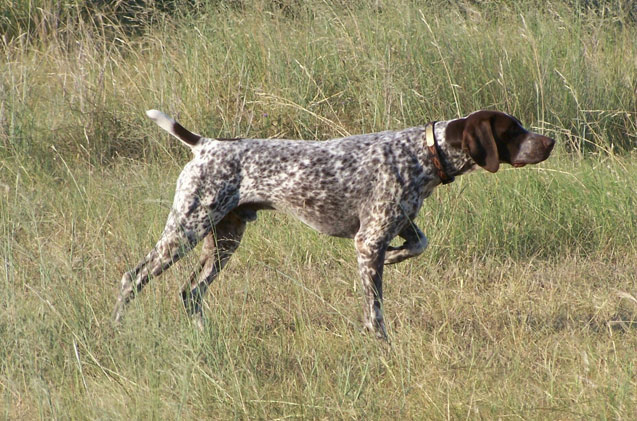
Coco would be home alone and miserable. Dogs need their packs and solitary confinement makes them crazy. No matter how much I loved Coco, she would not be happy with our arrangement. She needed a family, maybe some kids, and lots going on around her to keep her mind bright and her spirits up and I could not give that to her.
As Animal Control drove away with her, I wondered what I had done and if Coco was really meant to be with me. When they called me a few weeks later to offer her to me I was able to say no, that she would be better off with someone else.
Two months after her accident, one sunny spring day, I took a call from a young man. He explained that he was looking for Coco’s medical records. He and his partner had adopted her the weekend before and she would have a new vet in Bellevue.
“Oh, I’m so happy to hear that! How is she?” (happy tears now)
“She’s great!” he replied. “She’s laying right here beside me on the couch with her head on my lap. She’s a great dog. We already love her. Oh, and we changed her name to Gracie.”
Perfect.
I promised to send him Gracie’s medical records and told him how thrilled I was that she had found a good home. She would have two active, strong, devoted young men to walk her three legs off and fill the void left in a dog that won’t hunt.

 Belonging