
June 12, 2019
“Therefore we are always confident and know that as long as we are at home in the body we are away from the Lord.” 2 Corinthians 5:6 NIV
To understand where I am today, I begin by telling you where I came from. My story always seems to carry a certain amount of discontent; why am I here and not there, what if I had been there, instead of here? Perhaps, this is the human condition or a restlessness that is a peculiar way of life for me. Contentment is easier to come by since retirement but, I think I will always be looking for one more adventure, one more reason to laugh, and one more, just one more dance.
~~~~~~~~~~~~~~~~~~~~~~~~~~~~~~~~~~~~~~~~~~~~~~~~
I gave the heuchera the same treatment as its fancy cousins in the narrow bed that borders the deck in my back yard but the little lime green beauty didn’t respond. It looked underdeveloped, wimpy and sad. But, before I dug it up and gave it last rites in the compost bin, I decided to give it one last, one last chance. I transplanted it a mere four feet over, next to the aggregate planter that held my pride and joy, Japanese maple.
Next to the planter it was cooler, shadier, and protected. Essentially, I put the ailing heuchera in the plant hospital and waited. It still received the same care as its more robust cousins but, surprisingly, as the weeks passed through the summer its leaves crisped up, like lovely summer lettuce. It filled out into a dense mound and began to thrive. There was no explanation, nothing concrete to point to, but the heuchera became the show-off of the flowerbed.
I’ll call her she, because she began to express her true, authentic personality, glowing with good health and vitality. In her new space she found her comfort zone, the place she had always belonged, but I, her gardener and tender of her life, hadn’t realized it.
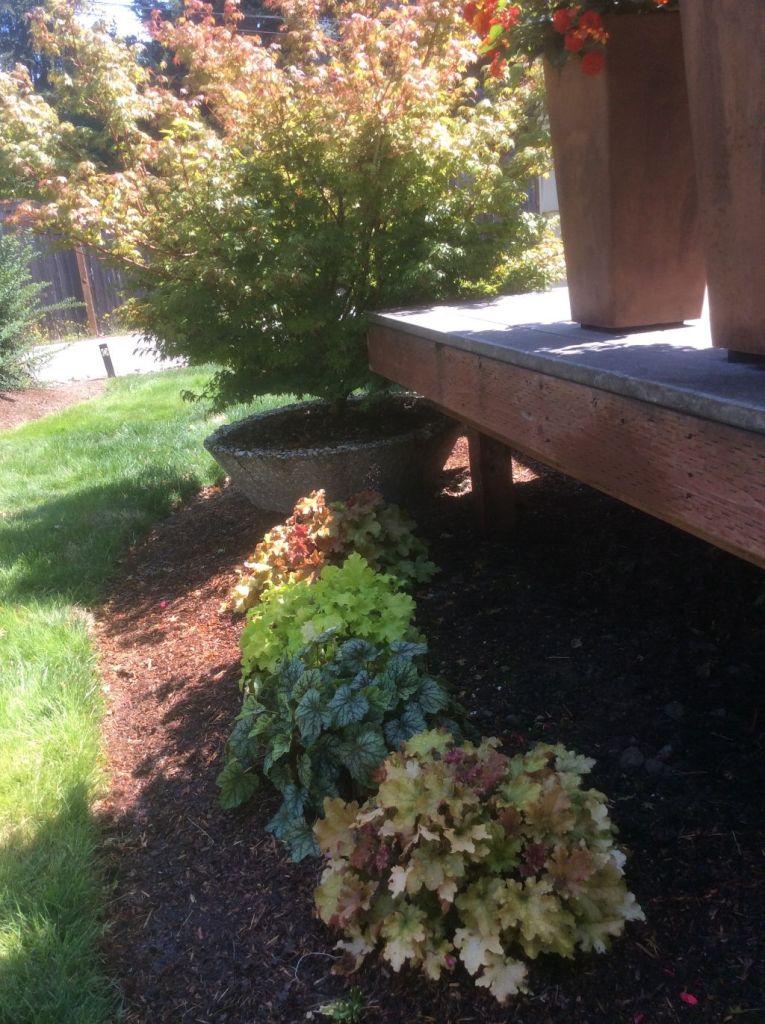
I have so many times felt like that heuchera, that I was in the wrong spot in the garden.
In my case, the transplant was not to the ideal spot for sun, water, and shelter, but a rocky place, where the wind blew too hard and the sun burned. My transplants were uncomfortable, lacking nutrients necessary to fulfill my spirit.
Some transplants were out of my control and some were my own poor judgment, because I turned a deaf ear to the whisperings of the Holy Spirit.
Some transplants caused me to grow stronger in order to keep my roots and maintain my balance. Like a scrubby pine growing in the cleft of a rock, I bore down, leaned into the wind, and toughened my bark.
And, some transplants just left me longing for softer soil, warmer winds, and thirsting for a cool drink of water. I knew where I wanted to be but, like the little heuchera, was unable to transplant myself. Where is a cozy greenhouse when you need one?
I look to the Master Gardener to change my circumstances but instead, His sovereign plan, mysterious and wondrous, nurtures me where I am. And, I too, strive to express my true, authentic personality, to glow with spiritual health and vitality. I yearn for my comfort zone but wonder if I was created to find such a place this side of heaven.
~~~~~~~~~~~~~~~~~~~~~~~~~~~~~~~~~~~~~~~~~~~~~~~~~
A Tale of Two Soils
June 23, 2019
The gumbo of Montana and red Oklahoma clay.
My parents were born and raised in Oklahoma and all my relatives lived in that warmer clime. Dad’s job, working in the oil business, forced relocations creeping northward. My earliest memories were in Wyoming, then to the cold prairies of Montana.
Our little town sat at the edge of the Badlands, on a bluff above the Yellowstone River.
Badlands, eroded, gutted, deep gullies, scarred. Hilly fingers reach into my neighborhood; Hungry Joe was my back yard. A sudden summer storm sent silt flowing down the hill into the yard, covering the patio in sludge, leaving behind a hill of “gumbo,” an impenetrable mound. After a deluge we used a snow shovel to scrape the patio clean.
Hungry Joe; I always thought he must be a local Indian, a legend of lore. But, Hungry Joe is a white guy, who operated the ferry that crisscrossed the Yellowstone River, muddy and swift. He got his name because at noon, no matter the circumstances, no matter who might be waiting transport, Joe walked away in search of his lunch. Joe was hungry.
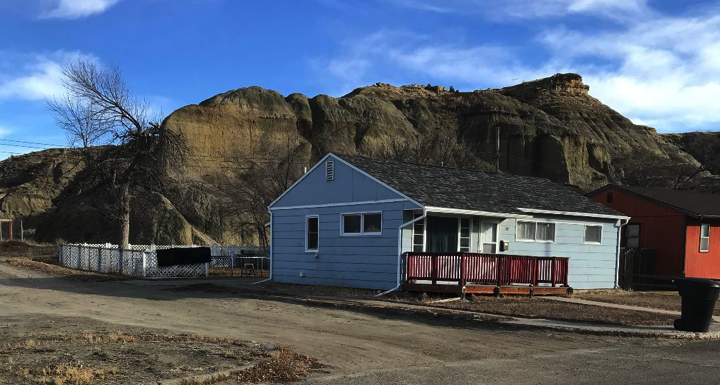
Little grows in the Badlands, concealing secret dinosaur history. My brother hiked into the hills with an archeological hammer and returned with bone fragments and petrified clusters of tiny seashells, evidence of past Cretaceous sea beds, an amateur paleontologist. He removed his clothes from the drawers, stashed them in his closet, to make room to display his treasures.
And God said, “Let the waters below the heavens be gathered into one place, and let the dry land appear”; and it was so. Gen 1:9 NASB
The Yellowstone River, thick and swift, home to pre-historic Paddlefish, with ugly snout but prized for its roe. In winter the river freezes over solid, a mini ice age. Come the spring thaw, huge chunks break up, like a shotgun going off, crash to shore and pile up, with glacier-like power, moving trees, trucks, anything in its path.
Winter roars onto the bare prairie too soon in a rush of cold wind and snow. Icy grains scour low across the highway and fields of stubble. Forty below. Ice crystals glint in the hard, cold air; sundogs run rings around the early morning sun. Forty below. Winter stays too long, nerves fray, and red Oklahoma clay beckons.
Each summer we leave the Montana gumbo, our southern migration, in search of red Oklahoma clay. The land is softer, genteel, tropical, the air dense with heat and humidity, and cicada vibration, Oklahoma’s own Cretaceous remnant. Vegetation is a thick blanket, kudzu folding over in its land flow.
Then God said, “Let the earth sprout vegetation, plants yielding seed, and fruit trees bearing fruit after their kind, with seed in them, on the earth”, and it was so. Gen 1:11 NASB
Life is slower, kinder; family waits to surround, embrace. I only saw Oklahoma in the summer so the other seasons didn’t exist. In my mind, it was always summer in Oklahoma.
Fans hummed in every room day and night. We slept uncovered, but for our sweat in the thick darkness. Grandpa lays on a cot in the back screened-in porch, in his boxer shorts, listening quietly to baseball on the radio. I knew he was there but the inky night concealed him.
By day, Grandpa trudged around in denim overalls, tobacco pouch in his pocket, oilcan in hand. I followed him around to see what developed.
He cut off a plug of tobacco and popped it in his mouth, offering a plug to me, “Hey, Sis, wanna chew?” for the fun of hearing my shrill little girl squeal, “Eww, Grandpa, that’s gross!”
The mysterious oilcan squirted slugs and snails with kerosene; they writhed and spasmed before turning to a slimy mess.
Later, I followed Grandpa to the garden, the sun high overhead, saltshaker in hand, to indulge in warm, ripe tomatoes, salty brine awakening the taste buds. Bees, butterflies, and a little girl moved slowly in the drowsy heat.
A bunker burrowed into the back yard, deep, cool and musty, filled with Grandma’s canned goods, and ready for disaster. We were in tornado alley and always on the lookout. Grandma was terrified of the beast storms, refusing to live in any house that did not have a storm shelter. I never experienced a tornado but the subterranean cave thrilled and chilled.
Two soils, so very different; one feels foreign and unfriendly, the other the scent of a home I had never lived in. Yet, I grew up in the foreign but longed for the familiar I’d never known. Is it the longing for Oklahoma or just the Home yet to come?
~~~~~~~~~~~~~~~~~~~~~~~~~~~~~~~~~~~~~~~~~~~~~~~~~~
June 30, 2019
Today I take the artistic license of blogging to insert a bit of humor. I worked in veterinary clinics for years and came away with a wry outlook on human nature. The animals are predictable and true to form…humans, not so much.
Old Hippies
Dogs and cats come in a variety of breeds. With dogs it is easier to differentiate a Lab from a Pitbull, from a Chihuahua, from a Poodle. While cats are usually just Domestic: domestic long hair, domestic medium, and domestic short hair. Occasionally, we see a Bengal, Norwegian Forest, or Main Coon.
I have observed that our clients also fall into a variety of breeds. These breeds are not always the most obvious.
There is a particular breed of client I call Old Hippies, who may or may not be cross-bred with Vietnam Vet. These guys all have one thing in common: pot. They love it. They waft into the clinic in a dreamy cloud of the stuff with a mellow, perpetually cheerful, go-with-the-flow attitude. I know I can relax around this breed. They have no sharp teeth or claws left; their points have been rounded off by a whole lot of living. Like the grizzled old dogs that they are, they plod along with just enough energy to wag their tails. Around them I can take my professional posture down a notch and rest a bit. These guys don’t stress about the traffic, they don’t care who runs for President, its all good, happiness is just one smoke away.
Sam is a tall guy with long gray hair that is always pulled back into a pony tail at the nape of his neck, a beard and mustache that curls up on the ends, giving him a permanent smile. He has a cat named Brick, named after the Commodore’s song “Brick House.” Never mind that Brick is a male. You know the song:
She’s a brick house
She’s mighty mighty just lettin’ it all hang out
She’s a brick house
The lady’s stacked and that’s a fact
Ain’t holding nothing back
Every time he comes into the clinic we both say “Brick” at the same time and giggle. It is our little inside joke.
Once, Brick became ill with an undiagnosed malady. He spent some time at the ER and a few days in our clinic on supportive care. Sam was beside himself; Brick is his sole companion. I ran into Sam in the parking lot during this worrisome time. He began to tell me about his sister, struggling with breast cancer, the recent passing of his mother, and now Brick’s illness. He wept openly, then directly asked for a hug. We shared an awkward moment as my eyes darted around the parking lot, hoping no one was watching, hoping he wasn’t reading anything more into that hug.
Thankfully, Brick recovered and we have resumed our old relationship.
“Brick is here to get his nails trimmed.” Sam’s eyes twinkle and we share our inside joke again.
Carl stood before me at the check-out counter one evening. He is about my height, with wiry, gray scarecrow hair that sticks out from beneath his baseball cap, and a dusting of gray whiskers sprinkled across his heavily lined face. He waits quietly for his pet’s medication. Pandora is playing Golden Oldies and begins to croon,
One toke over the line, Sweet Jesus, one toke over the line.
At this, he rallies and notices I am there. He gives me a wolfish grin, showing yellow teeth from smoking too much whatever, and remembers his favorite joke.
“Do you know what the two most popular words were in the 60’s?”
I cut my eyes sideways and suppress a grin, “No….”
Still grinning, he says, “Wow and ear.”
“Ear?” A giggle is percolating deep inside me.
With pinched fingers and puckered lips, he takes a long, wheezing drag on an imaginary joint. He hands me the toke, squinting in the imaginary smoke, and squeaks out, “…’ere.”
We both burst out laughing.
I have never tried pot, I am marijuana virgin, but in that moment, Carl and I are compadres, having a few laughs, sharing an imaginary joint, having an imaginary pot party.
Glen is a giant of a man, standing at least 6’5”. Like a Viking specter, his gray hair falls to his shoulders and down his back. He wears an old, cracked leather jacket and is decked out with heavy silver chains around his neck and wrists. Every finger has a chunky silver ring, one is a skull with blackened eyes. When he smiles there are those long, yellow fangs again. He must really love that stuff. As he towers over me, I look up at him with a deer-in-the-headlights look of fear and awe, dumbstruck. But, then he opens his mouth. Turning to the woman client next to him, he says, “What a pretty little kitty you have!” And to another, “Such a precious puppy!” As he heads for the door, in a crackle of old leather and jangling jewelry, he tosses back a curtain of hair and throws me a girlish wave, exclaiming, “Have a lovely day, ladies!”
Pot is legal in Washington State now and I want to recommend it to some of our more uptight clients. It would do wonders for their dispositions and make my job a whole lot more fun.
~~~~~~~~~~~~~~~~~~~~~~~~~~~~~~~~~~~~~~~~~~~~~~~~~~
July 4, 2019
Reluctant Sacrifice
I wrote this story years ago to remember my own son’s service in the Army, of what he went through, and of my own reluctance to give my most precious child to our country’s defense.

With dismal regularity our country flexes its muscles and grows restless to practice the Art of War, cautiously inching nearer to the flames, trying not to get burned. And, with dismal regularity the political climate reaches flashpoint, sending America’s sons and daughters to smother the flames. Each time we enter the fire unwelcome memories bring back the fear I once felt for my own son.
He was half way through his senior year in high school when he announced he would join the Army after graduation, the last thing this child of the Vietnam era wanted for her child. His route would not be an easy road, but the rugged, treacherous path of an Airborne Ranger. This elite piece of the military machine stealthily conducts ambushes, raids and reconnaissance, most often in the black of night.
It would be another year before he would be accepted into the fearsome training school as part of the 75thRanger Regiment. I wrestled in quiet insanity, imagining the hardships awaiting him, the unimaginable challenges of his body and soul. For his part, youth is blessed with the inability to fathom the worst that can happen.
At that time, Ranger training consisted of 4 phases: Darby, Desert, Mountain and Jungle; each phase lasting approximately 4 weeks, with a day of rest between. In an effort to simulate the stress of actual combat, they receive one hour of rest and one meal a day. The MRE’s, meals-ready-to-eat, are designed to give energy and sustain the soldier’s life, but not necessarily to maintain his health. The conditions of depravation wreak havoc on his mind as well as his body. As the soldiers begin to weaken physically and emotionally they are pushed to their limits to “Run, feel no pain, run, food and sleep are crutches! Rangers lead the way!” The objective of their commanding officers is to break down the spirit then build it up again. “Can you take it? Go ahead, quit! Do us all a favor and fail!” Their plan weeds out those with normal tolerance for pain and suffering quickly, while the survivors rush on into the next phase.
Darby, meant to sharpen and hone skills, contains equal amounts of abusive hazing. Hunger and fatigue gnaw at their insides. “Can you think of anything but food and rest? Can you take it? Go ahead, quit! Do us all a favor and fail!”
After a day’s rest they head for Texas and the Desert Phase. There the heat saps their strength and confuses an already fuzzy brain. Many suffer dehydration and heat stroke; a condition one never fully recovers from. Once overtaken by the heat, these men become vulnerable and from then on, a weak link in the group. Hot dusty winds suffocate them by day, replaced by frigid cold as the sun goes down. Visions of food crowd out the more important issues at hand; watch for snakes, scorpions, the enemy. A hamburger rolls by in a gust of dusty heat, but no, it is only a tumbleweed. I awaken at odd hours in the middle of the night, heart pounding and, staring into the darkness, wonder, Is he in pain, is he afraid, is he lonely, is he all right? Only silence answers my fears.
Month three begins with the Mountain Phase in the rocky terrain of Georgia where they are on the move 23 hours a day. Their packs weigh 75 pounds, filled with gear and extra socks. A soldier’s feet are his most vital body part and must be preserved at all cost. No need for a sleeping bag; there will be no sleeping. No need for extra warm clothing; warmth invites sleep. Son is one of the bigger guys so he carries an additional 25 pounds as the beast of burden for a machine gun and ammo assigned to him.
His journey is torturous, hiking up rocky hillsides, tumbling down the other side through blinding brush. Only the stars overhead offer weak light in the dense forest that surrounds them. Don’t light a fire, the enemy will see you! Put your MRE inside your one layer of clothing, next to your body; that’s called a warm meal. Shiver until your bones ache and stiffness sets in; stop chattering teeth! Hoard salt and sugar packets to indulge in one flavorful bite. At home I worry, I pray, I hate the unknown.
While the physical rigors go on and on, the soldiers are assigned missions. Can you think clearly, make a sound judgement, look out for your men and the enemy, as well? Each man takes his turn in control of a group of nine. The success or failure of the mission falls squarely upon the leader: set up perimeters, assign watches, form a plan of assault, execute the mission and pray that each man stays awake to do his part. Unfortunately, on Son’s mission, a man is found asleep; the mission fails, so the group fails. These nine men must repeat the entire Mountain Phase and endure an extra grueling month.
While on the break between phases, care packages from home deliver rich and fattening foods to satisfy the cravings and letters to quench thirsty souls. The men plead for cookies, candy, home-baked anything and especially, anything with peanut butter. I send huge amounts knowing I am feeding more than one starving young man. And I send this psalm (121) to my son on the back of a recipe card:
“I will lift up mine eyes to the mountains; from whence shall my help come? My help comes from the Lord…He will not allow your foot to slip; He who keep You…will neither slumber nor sleep. The Lord is your shade on your right hand. The sun will not smite you by day nor the moon by night…He will keep your Soul…From this time forth and forever.
He carried this card with him out into the Georgian mountains to try again and read it when his spirit longed to give in and give up.
The final phase takes place in the swamps of Florida. There conditions simulate combat in the jungle. Chest deep in frigid water for hours without end, their energy quickly drains away. Bugs drive them crazy. But the light lies somewhere ahead in the mist; the end is near, maybe there is life after a walking death. Three weeks later, when the next class came through, four young Rangers died of hypothermia in those icy Florida waters.
Nearly five months after it began, Son’s ordeal ended. Of the 425 who started, only 102 finish, he is the youngest. His slender 6’3” frame dropped 50 pounds and malnutrition caused infection in his knees. I try not to let this mother’s mind run wild with worry.
Three years later Son received his discharge while the government held claim to him for five more years, should we jump into war’s flames feet first.
I have not been to war but I have felt its heat, a heat that sears and scars forever. Its flames will flare up again and our country will beat its chest and draw lines in the sand to prepare, once again, to practice the Art of War. Other mothers will lay awake in the middle of the night while their sons and daughters put their lives upon that line. I try not to become complacent about those who are sent to our defense and remember they are someone’s son or daughter, someone’s husband or wife, someone’s father or mother. And, I secretly worry and selfishly pray, not my son.
Post Script: From now on, Son’s frostbitten hands will cause him pain whenever the temperature drops and his feet will never be the same. He recently had 3 vertebra in his neck fused together…residual damage from carrying so much weight on his back and hard parachute landings. But, thank God, he is alive.
~~~~~~~~~~~~~~~~~~~~~~~~~~~~~~~~~~~~~~~~~~~~~~~~~~
July 11, 2019
Persona Non Grata
Yesterday I dodged a bullet. I was called for jury duty and got a last-minute stay of execution the night before; I did my happy dance.
I have an aversion to jury duty since getting caught up in the process and hope never to experience that again. I’ve seen what the legal dogs do when they get a tasty bone. Try to take a bone from a dog and see what happens.
A friend told me that only 15% of those summoned actually show up; they just don’t report! My luck, they would come after me, so being given a legitimate open door suits me just fine.
~~~~
I’ve been told it is a civic “privilege” when called to jury duty but it felt like anything but. Reluctantly, I reported for jury duty after being assured, over the phone, that it would take three to five days, at the most. I envisioned being sequestered for months while my life went on without me. Irrational perhaps, but still these thoughts made me uneasy and uncooperative. I told myself, It’ll be fine.
After the first uneventful day, I reported a second time and was presented with a questionnaire, giving a brief overview of a case. My first clue to the gravity of my situation came when it is implied that the trial could last up to six weeks. Filled with dread, I answered the questions and waited for the next step.
I became one of a jury pool of 120 people necessary to sift out twelve jurors and four alternates. A handful of us answered the questionnaire in such a way that sent up a red flag for the legal eagles involved. We small few will have to account for our answers, individually, and alone.
When my turn comes I am ushered into the courtroom to sit alone in the jury box, confronted by two lawyers from the prosecution, two from the defense, the judge and her staff, and most unsettling of all, the defendant, himself.
I made it clear from my answers that I was not a willing party. “If you are called to serve on this jury, can you give it your best effort? Will you be able to be impartial and totally fair-minded?” Trying to keep my voice from shaking, I speak the truth. “I don’t know.”
The Assistant DA’s voice raised a notch as he grew impatient with me, “This is going to be a very big case. Aren’t you at all interested in being a part of it?” The big case was going to include pictures of the badly decomposed bodies of two murdered women.
We glare at each other; he shakes his head in frustration and sends me home for the day.
On day three, I am called for a second reaconing, again before the entire tribunal. One of the questions referred to reports on TV and in the newspapers. Had I remembered hearing of the murders when they first arrested the defendant and what, exactly, did I remember?
I did remember something but struggled with recall and became undecided. Did I remember everything correctly? Perhaps I am confusing this situation with another murder I had heard about. At this point, I have nothing to loose by being totally honest.
My honesty didn’t buy my freedom; I report on day four for the Voir dire.
Voir dire: a process of speaking the truth to determine competency to be a witness or juror.
This part of the process required all those remaining from the jury pool, approximately 80 of us, to be in the courtroom together. We filled the jury box as well as the entire section designated for the spectators.
The lawyers take turns, one hour each, expounding on one element of the case, then questioning various potential jurors on their perspective. Speaking in vague and general terms, I recognize the game of cat-and-mouse. It is up to us to decipher the lawyer’s intent, to read between the lines.
“You’ve all had problems with relatives before, haven’t you? Ever had an argument? Possibly in the heat of anger, said things you didn’t mean, made threats?”
The defendant, Gary Wayne, a machinist from Snohomish County, despised the mother of the woman he lived with. The feeling was mutual and she had threatened to go to court for custody of the couple’s children. One night, in a drug-induced rage, Gary allegedly had gone to the woman’s apartment, they argued and he killed her. Two months go by before passengers from the Spirit of Seattle Dinner Train spot her body lying near the tracks.
“Anyone here have any problems with drugs or alcohol? How do you feel about someone who does use drugs or alcohol?”
The Assistant DA took his turn as I tried to sink lower in my chair, to dissolve from his field of vision. No such luck; he calls on me. Oh, well, why change his opinion of me now?
I explain, “Yes, I do have a problem with drugs and alcohol. There are alcoholics on both sides of my family so I might be genetically predisposed to addiction. I am a teetotaler.”
If only he knew how much of a square peg I really am, raised a Southern Baptist, where dancing was once frowned upon and alcohol has no redeeming value. I am a square peg in a round hole in this group.
These questions referred to the second accusation against Gary Wayne. A few weeks after the murder of his partner’s mother, Gary and a female childhood friend went off for a weekend of camping. They drank too much and, in a slip of the tongue, he admitted the deed.
Days later, sobering recollection sends him a jolt. She was, after all, his good friend but could she be trusted? Apparently, not enough to save her life. His friend’s body was found weeks later deep in the woods of the same campground where he’d made his untimely confession.
Confession is supposed to be good for the soul, right? What will it do for mine?
The defense attorney began, “Our system is based on the belief that 99 guilty men should go free rather than one innocent man convicted. How do you feel about that?”
As with much of America at that time, I am soured on our system of justice after such debacles as the OJ Simpson trial and the nanny who was freed after shaking an infant to death. Where is the justice in that? We have all heard of work-release programs in which the criminal is allowed small freedoms, enough freedom to go back and take revenge on the person who put him in prison. Our justice system, it seems, bends over backward to protect the criminal with secondary consideration for the safety of the general public.
The ax falls on me again and I speak my piece. What was that? Did I just hear a pin drop?
Weary and worn, we are called to a recess and ushered down the hall to be locked in another room. Great precautions are made to insure that the potential jurors do not see the accused man walking the halls in handcuffs; it wouldn’t look good for him, you know. As we are moving along, one of the men in the group leans over my shoulder from behind and chuckling, whispers in my ear, “You don’t need to worry, they won’t want you!” I feel backward and stupid. Somewhere in the evolution of my life I have missed a link and failed to become an enlightened, liberal thinker.
The sixth day into the process, we were confronted with the final subtle, but frightening, implication. “This is a very serious crime. We may need to seek the maximum penalty. Can you accept this burden and carry out your duty, if required?”
There is no doubt about this one; the prosecution would be seeking the death penalty.
Ouch! My square edges bang into that round hole again. I am a conservative contradiction of terms: pro-life in abortion, pro-death penalty in crime. It’s easy to talk of the death penalty until confronted with the possibility of enforcing it. This is a chilling reality and, thankfully, I am not asked to air my position.
Finally, all parties exhausted, the voir dire ends. Now began the actual selection of the jury. We were given numbers as identification through this whole ordeal and mine is #58. At last, I was called. “#58, you are excused from duty.”
There. It has been declared. I am unacceptable for this civic duty; persona non grata. The desirable juror is liberal and fair to a fault, with no biases, no moral high ground. It now comes to me, in glaring clarity, how far from the middle ground I stand.
Epilogue: A mistrial was declared on the opening day of the trial after the prosecution blundered, implying that the accused would not testify due to his guilt, violating his right not to testify. The jury was excused and the whole exhausting process repeated. After an eight-week trial, Gary Wayne was found guilty and sentenced to life in prison without parole.
 Belonging