By Cheryl Goff Yates November 2022
For nineteen months the dream of a Mediterranean cruise shimmered on the horizon, ebbing and flowing with the waves of Covid. We put down the deposit but the reality seemed far away, remote. These days it’s never a good idea to plan too far into the future; all could change in a day’s time.
But last spring the dream took hold and Steve and I committed to make it happen: eight nights, Athens to Barcelona on the aptly named Jewel of the Seas. Dizzy with excitement we purchased plane tickets adding two additional days in Athens before the cruise and three days after in Barcelona. We secured reservations at boutique hotels in the heart of the two cities, with tours of the most important sights.
Our cruise included a new port every day for seven days. Eager to see as much as possible, we scheduled excursions for every day. So what if we were overbooked, this is no time for sleep and leisure, we must see it all, soak up the Mediterranean in all its glory.
Throughout a long, hot, smoky summer we waited, planned, tried to think of everything, plan for every contingency, until October finally arrived. Our plane made a wide arc over Canada, Greenland, and Iceland before swooping down into Europe, southward toward the crystalline blue-green Mediterranean Sea.
Sixteen hours later we landed in Athens, both ancient and ultra modern at the same time. The buildings are old, older than our country by a 1000 years. They don’t tear down to build new; they remodel and renovate constantly, turning archaic spaces into sleek, hip venues for the super cool to be seen.
The cab driver unexpectedly slammed on the breaks in front of iron bars set into a blackened brick wall and announced that we had arrived at our hotel, Belle Epoque. My heart sank as I surveyed the surrounding worn stone walls covered in graffiti. But then the iron doors opened, welcoming us into a tiny lobby barely wider than the doors, wrapped in marble and glass, the model of elegance and efficiency. Our room on the second floor was equally luxurious, using every inch of space in the spirit of good taste. Ten-foot French doors opened to the narrow street below packed with shops, bakeries and baristas in defiance of the graffiti.
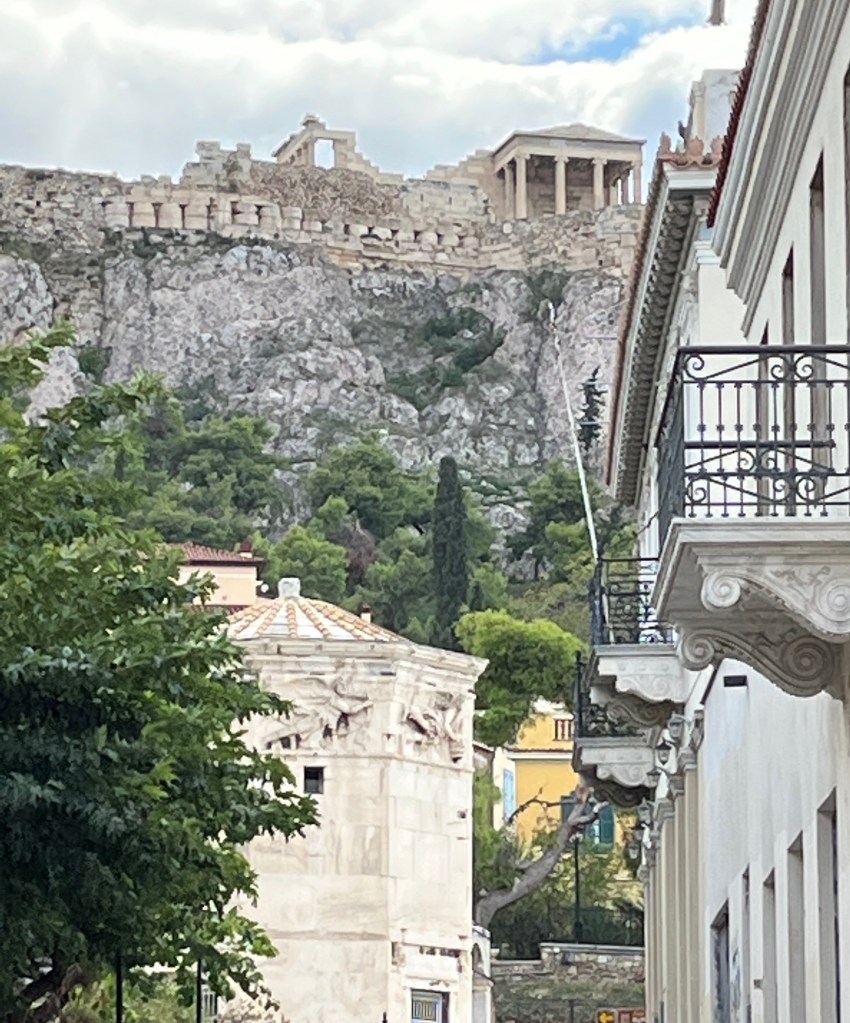
We planned with intention for everything to be within walking distance of our hotel. Day one was for exploration before our tour of the Acropolis so we began walking up and down the busy little byways, mere alleys. Each business, barely wider than a typical garage door, was filled with shops, restaurants, coffee bars and pastry shops, the later on nearly every corner. Chocolate croissants and lattes became our daily staples. We ate our way through streets dotted with ancient ruins.
The Acropolis reigns high above the center of the city, the birthplace of democracy, homage to countless lesser gods, and imprinted with the footsteps of the Apostle Paul’s ministry to the Gentiles. Our guide filled our heads with information as we walked among the towering columns soaring overhead. All accounts, all events and dates radiated from One Event, the birth of Christ. Throughout all that we would see on our travels, the birth of Christ was the focal point from which all other events would orbit, like planets around the Sun.
“For passing through and beholding your objects of worship, I even found an altar on which had been inscribed: To an Unknown God. Therefore whom you worship not knowing, Him I proclaim to you.” Apostle Paul, Acts 17:23
Sunday, the day before boarding the ship, we hustled to the Parliament Building where the Tomb of the Unknown Soldier stood silently in the square before. Two Greek soldiers keep watch night and day. Their uniforms appear more like costumes, foppish, with short, billowing pleated skirts and clogs with pom-pomed toes but they carry themselves with such dignity and grace, it is impossible not to admire them. After a slow, solemn change of guard, military parade music begins to swell and a full band makes its way down the street and onto the square. Those guards just relieved of duty join the procession and the parade resumes in reverse. Such honor and devotion to the Unknown Soldier is performed every Sunday.

Our afternoon is free to stroll around town, basking in the warm sun. We are surprised by fenced off areas on every block to protect Grecian ruins of yesterday, woven into life today. Marble paves the city streets, sidewalks, even the curbs are slabs of the cool, gray stone.
Greek Orthodox churches opened their doors to reveal gilded sacred spaces paying tribute to Christ, Mary, and a multitude of saints, all portrayed in classic icons. Without knowing, this would begin our journey through many churches that allowed moments of quiet reflection and prayer. We ended our time in Athens at a sunny street side café with refreshing Greek salad, shaved lamb wrapped in warm pita bread and tangy tzatziki sauce.
On day four we board the ship, now anticlimactic to the wonders of Athens. We find our stateroom, unpack and settle in. This will become our home base, a place to rest and recharge, to prepare for our next adventure through Greece, Italy, France and Spain. Each morning we awake to find a new world before us, each night we wave goodbye from our veranda, watching the sun set over deep blue waters and sunwashed cities perched on stone cliffs.
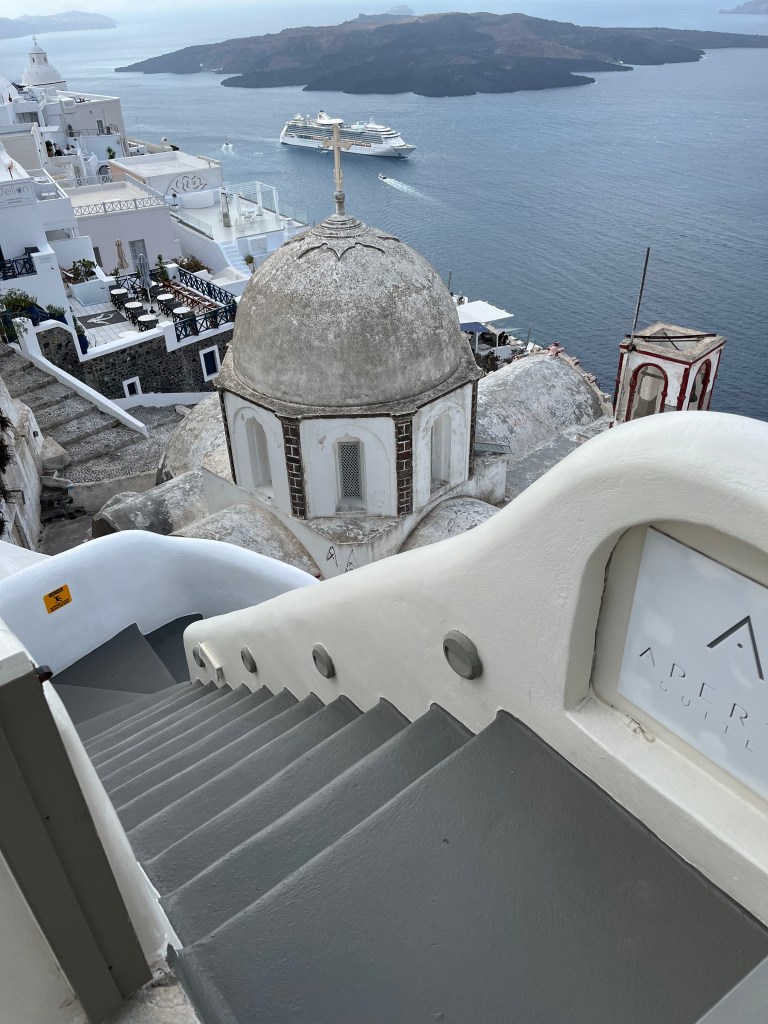
Our first port of call is the village of Oia on the Island of Santorini. A bus hauls us up a steep rugged road, the surroundings barren and dry, not at all what we expected the Mediterranean coast to look like. There is little vegetation but patches of cactus flourish. At the top of the island, clinging to craggy cliffs is the village of Oia, stunning whitewashed buildings, the occasional brilliant blue rooftop, pots overflowing with vibrant flowers, the stuff of calendars and travel brochures, vacation getaway for the rich and famous.
The village is one continuous maze of small shops and apartments connected by pathways and steep stairways, and from every angle is breathtaking views of the expansive bay below, a sunken caldera in the Aegean Sea from a long-ago volcano.
We walk through the narrow paths through high-end shops filled with designer purses and shoes, glittering diamonds and precious stones. A beautiful young woman models a flowing red dress for a camera shoot in the town square. I’m convinced Brad Pitt must be hiding in plain sight but I never find him.
We are given a sneak peek into luxury homes with small emerald pools set in gleaming white. While others from our group shop we find the perfect spot for lunch, sharing the view of the elite. Once again, we relish Greek salad and warm lamb. For this moment in time we are living the life of the privileged.
When it’s time to go back to the ship we do not go the way we came. Instead, we take a short breathtaking route down the mountain in a gondola. It was the kind of day that makes you glad to be alive.
The following day we arrive in Katakolon, Greece to see the original site of the first Olympic Games. How exciting is that? Turns out not so much.
Up to this point, I have been snapping pictures continuously with my trusty iPhone. It’s camera sees beyond the limitations of my eyes and gives fabulous results. But this excursion leaves me uninspired and I don’t take a single picture. I felt cheated, robbed.
The Olympic “village” turned out to be a vast grassy area with a few columns and a lot of tumbled down stones. We are told to imagine what it was like. Imagine a training arena here. Imagine a massive statue of Zeus in the center who presides over the events and is worshipped. Imagine over two hundred statues of prominent citizens set on pedestals scattered throughout the grounds. Imagine it all. I imagine myself sitting by the pool onboard ship. The excursion culminates in a bus ride through the touristy part of town where we are set free to buy trinkets, support the local economy. Moving on…
Our third port of call becomes our favorite: Taormina on the Island of Sicily, our gateway to Italy. Another long bus ride through the ordinary finally climbs into rarified air to the storybook town. Elaborate buildings rise above us on all sides, balconies overflowing with tailing vines and flowers, ornate arches circle overhead. The narrow streets only allow for foot traffic that take us by more high end shops, kitchen shops, bakeries and outdoor cafés. And then, there is the always present, magnificent ocean view that makes the Mediterranean so irresistible. After a quick survey we settle into a sidewalk café to people-watch over bruschetta and spaghetti carbonara. I do love to eat and this does not disappoint.
As we eat we begin to make plans to return. What route would we fly to get here? Let’s rent an AirBnb for 2-3 weeks, live like the residents, be temporary expats. I will shop for olives, oils and spices to cook the local fare. We’ll visit the ancient amphitheater and gardens we didn’t have time to see the first time, rent a car and drive the Sicilian coast. It’s a grand dream but I’ve learned to dream big and sometimes dreams do come true.

The churches are now Roman Catholic in the traditional layout of the crucifix. Light floods into these spaces from stained glass windows, there is less gilt.
Day five, we awaken to the Amalfi Coast, Salerno, Italy. I am loving Italy and today is a big day as we prepare to meet Pompeii. We’ve heard about the legend of Pompeii since grade school, about the sudden destruction from the eruption of Mt. Vesuvius, of time frozen in place for the citizens.
Our guide is a scrappy little Italian named Antonio who knows his stuff. We’re surprised to learn that the guides on our excursions have Masters degrees in art, history, or both. They are founts of knowledge, talking for hours with perpetual enthusiasm. Antonio walks us through paved streets of the ghost town, once situated in a thriving trade route.
Merchant shops intermingle with the homes of well-to-do patrons. One shop has large clay pots sunken into marble counter tops: fast food in 79 AD. Next to it is a refined home with ornate mosaic floors, a central courtyard with bubbling fountain and frescoed walls of red and gold. A wealthy businesswoman ran an inn, complete with baths and private gardens. The bakery wrapped around a corner and still contained a large stone bread oven.
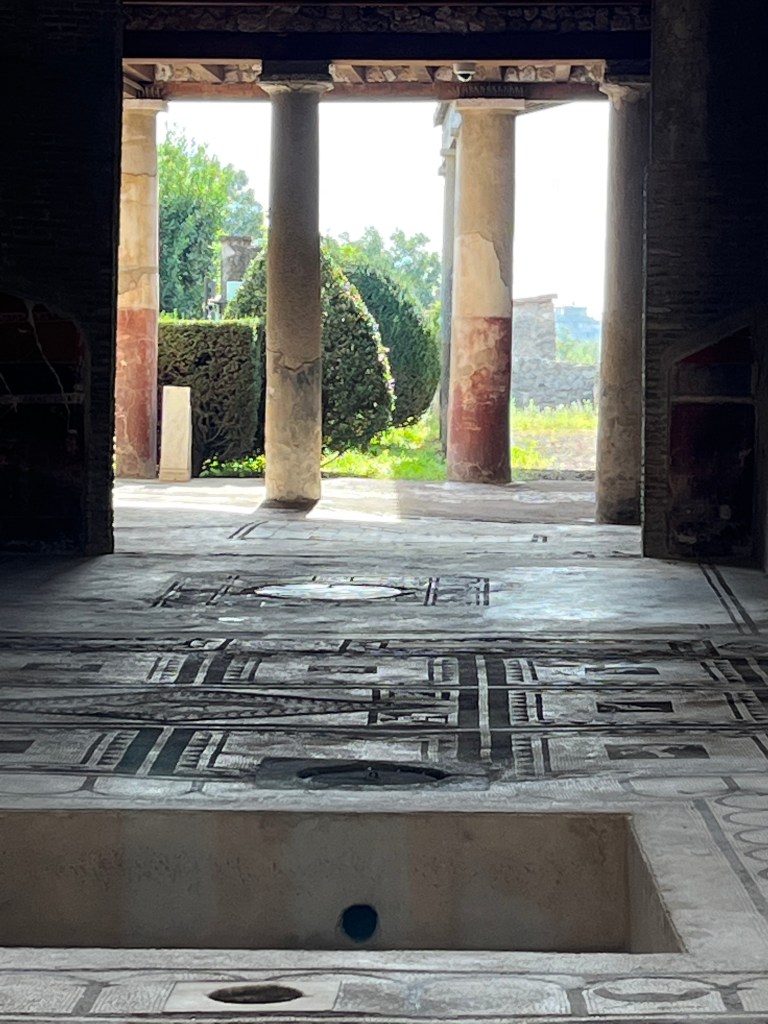
These people were prosperous, lived a refined life until Vesuvius roared and rained down tons of hot, toxic ash, burying the beautiful little city in a matter of hours. They were poisoned by gas and suffocated by ash.
A new city has built up around the ruins of Pompeii even as excavation continues. Vesuvius is predicted to display its power in the next 7-10 years, yet life goes on as usual.
Day six we arrive in Ajaccio, Corsica. It is a casual day with a casual, ho-hum tour of the birthplace of Napoleon. Though he is their claim to fame, there is no love lost in Ajaccio for the mighty little tyrant. His name and statues are everywhere. Our guide shrugs and sighs, “What can we do?” The only thing of interest to me was blocks and blocks of cemetery. During the Black Plague the Church refused to bury the victims in the church cemetery so the folks built their own “mini churches.” Row upon row of tiny stone mausoleums, like a miniature city, takes up the city center, each one unique and ornate. Artificial flowers pay colorful homage to the family interred and there are hundreds. Let’s go see what’s for dinner on the ship.

Day seven finds us still in France and we are in for a glorious day: a tour of Monaco and Monte Carlo. We’re advised to dress up, no slouches allowed.
As our bus enters Monaco we learn that only authorized vehicles are allowed entrance to the city. I immediately notice how clean and ultra modern everything is. Nothing is out of date, nothing worn or tired looking. New construction is everywhere, leaving nothing in need of care. We whiz through the business district then begin the climb to the historic city.
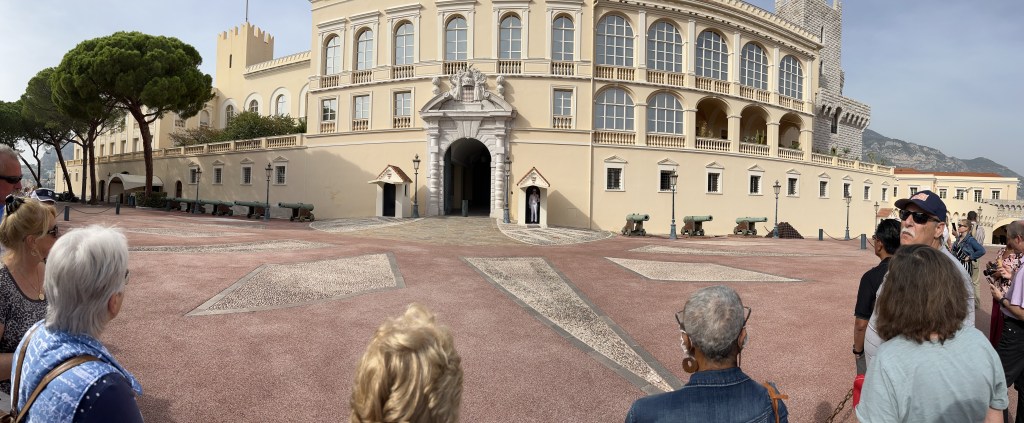
Monaco is a Princedom, ruled by Prince Albert and his home is within the inner sanctum of the historic area. As with all the desirable cities along the French Rivera, there is a magnificent view framing fairy tale buildings housing shops, restaurants, and the lucky few that live there. All surround a stunning square paved in marble, along with government buildings and Prince Albert’s castle. His flag flies high and is protected by guards. Outer gardens and tree-lined paths soften a row of understated mansions belonging to the rest of the royal family. Princess Caroline received one of them for her 21st birthday. What did you get for your 21st? Security guards make sure we stay on the path until it is time for us to move on to the real moneymaker.
Monte Carlo must be the most famous casino in the world. Our bus climbs even higher than the Prince’s castle to the pinnacle of Monaco’s economy. Wealth oozes out of the grandeur. Outside the famously recognizable Casino Royal is a row of Lamborghinis and Ferraris, also guarded by security. When one hapless tourist dares lean on one of the cars for a selfie, the guards freak out and shoo us all back. Away! Don’t touch the cars! Soon the owners float out of the casino, ignoring the obvious crowd of underlings, and cruise away to their glamorous dwellings. We can go into the casino for a fee, no pictures allowed; we choose to look on in awe. Next to the casino is Hotel Paris. I am sure I could not afford a night’s stay in one of those luxury suites. Designer shops, gorgeous gardens and fountains encircle these giants.

Monaco is the smallest country in the world, next to the Vatican, yet it lives in opulent wealth, relying on tourism and it’s lavish casino. The Prince and his wealthy benefactors have constructed a near perfect lifestyle unavailable to the rest of the world. Though a sovereign nation, but too small for an army of it’s own, it relies on France for protection in time of need.
As our bus descends our guide points out the location of the car accident that killed Princess Grace as her car careened around the twisting switchbacks of the rock called Monaco.
At our last port of call, Provence in Toulon, France, we are scheduled to tour an ancient castle but the night before Steve wakes me up. “I have a sore throat, I don’t feel good.” I had packed an emergency bag of OTC meds, including Covid testing kits. I dose him with Tylenol, then test him for Covid. The first test is negative so I try a different brand with the same results. Though relieved, I’m still anxious that we might both get sick with still four days to go in our travels.
We skip the tour of the castle, stay in our room, and I ferry food to him while we wait to see how bad he’s going to get. So far, I feel fine.
On day nine we awaken in Barcelona, Spain and disembark first thing in the morning. A cab takes us to Yurbban Ramblas, cool and snazzy just like our Athens digs. In the heart of the hotel is possibly the oldest elevator in existence, a fancy rod iron cage that holds two people or one with luggage. I take the marble stairs to the second floor and meet Steve with our luggage.
Steve is feeling moderately ok so he dons a face mask and we hit the Las Ramblas just outside our door.
Las Ramblas is the most fun street you will ever encounter; over a mile long to the coast and intended for pedestrian traffic, it allows for one lane of car traffic on each side. Down the broad center brick promenade the width of 3 normal lanes of traffic, crowds of people walk and shop, eat and drink. It is a place for people, not cars. Later we will learn that the foot traffic goes on night and day. Barcelona never sleeps. We do what we always do first, find a street café and order latte, tea and chocolate croissant in the warm Spanish sun.
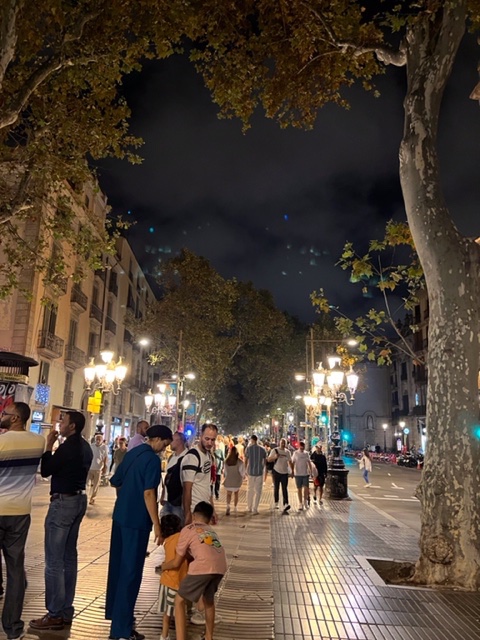
We stroll around old historic streets off of the Las Ramblas, me snapping scores of pictures for a while, until Steve needs a rest. He has begun coughing so we must take it slow.
We pass that first day taking it slow; rest a while, explore a while.
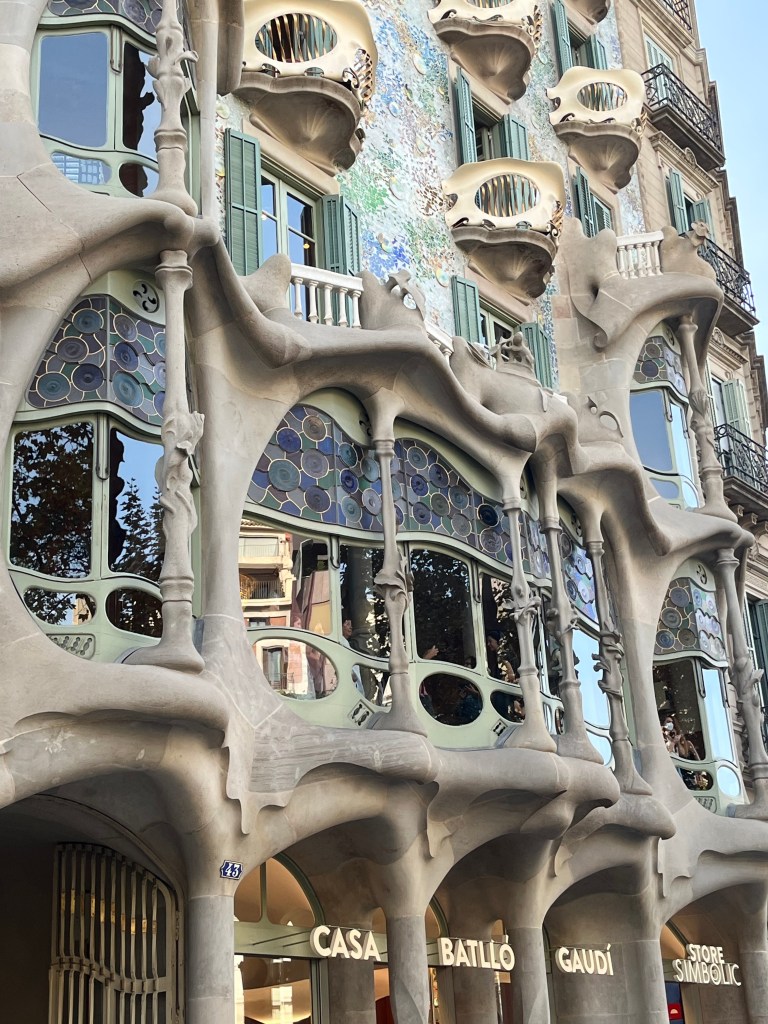
On our second day we explore the side streets off of Las Ramblas, sometimes finding quaint little burgs and Gothic churches. Steve’s cough has gotten worse; we slow our pace. In the afternoon we make our way to The Block of Discord. Three architects have designed three buildings, each a different style, and together, they form one building in a strange and bizarre mind-bending dream. There I am introduced to Antoni Gaudi.
Gaudi was most creative in the early 1900’s and he abhored straight lines. His building resembles melting wax: curved corners, heavy drooping balconies, and ornate rod iron railings in fantastical swirls and vines. Think Salvador Dali. His building is sandwiched between Classical Greek and Gothic. Tomorrow we will see more of Gaudi’s creations at Park Guell and Sagrada Familia.
That evening we dine at an outdoor tapas café in a small enclave off of Las Ramblas while a street musician plays classical guitar. We have little meatballs in tiny cast iron skillets, roasted potatoes and crusty bread with tomatoes, leaving room for gelato. The streets, cafés and bars are packed with nightlife. Barcelona never sleeps.
Steve had a rough night of coughing. We test him a third time for Covid. Still negative. As his coughing increases, so does my anxiety, the urgency to get him back to the US.
Come morning we make the tough decision that I will go on the tour alone and he will stay in our hotel room to rest. It is the second time Steve has tried to see Sagrada Familia; each time he is prevented.
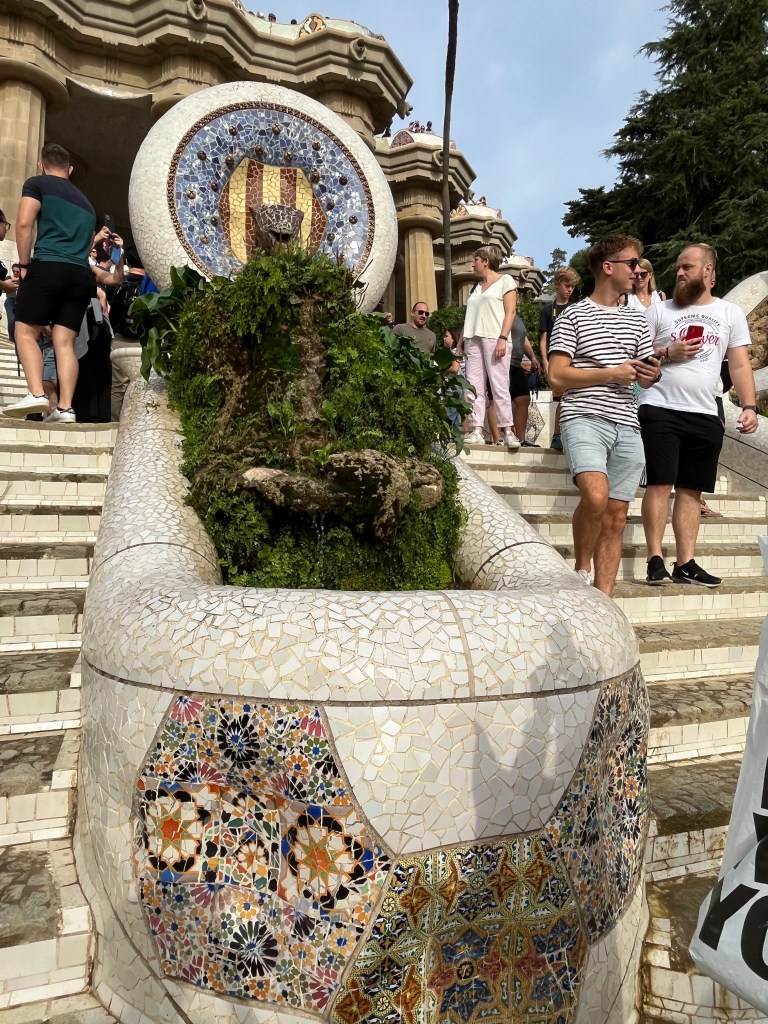
I join the tour group at Park Guell not sure what to expect. Gaudi purchased 40 sectors of land to build his dream park, a community for the wealthy to live within and enjoy nature. He envisioned 40 homes; only 3 were built. It seems the wealthy were less interested in nature, more interested in the bustle of high society life and the adoration of the common folk. By then he had built miles of stone paths with small conversation areas, fountains, a massive columned open market, and mosaic walls, all in the curving, sensuous lines he so adored. I’ve never seen anything like it before but Dr. Seuss comes to mind. From there we go by bus to Gaudi’s greatest creation of all.
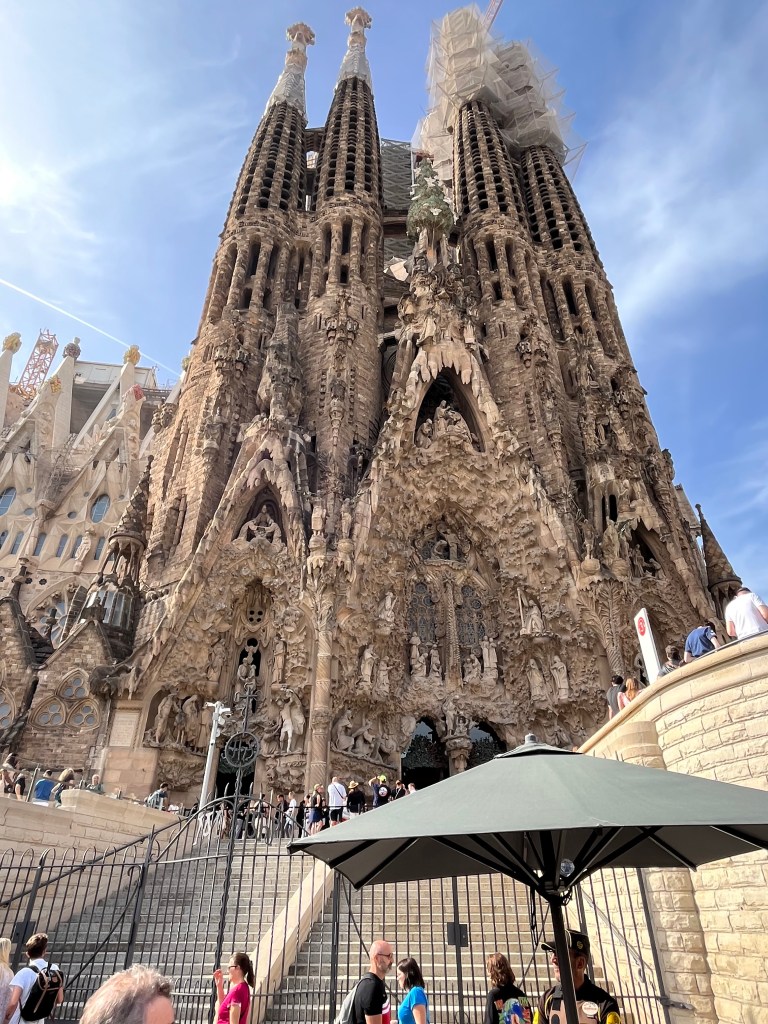
Begun in 1883, Sagrada Familia is a cathedral of spires: a center spire for Christ, one for Mary, twelve for the Apostles and one for Paul, a massive collection of spikes. Every square inch of the outside is encrusted with stone carving. Scenes from the life of Christ are situated amongst flowers, vines, birds, insects, plants and animals of every species. There is so much to look at the eye is overwhelmed. It is meant to symbolize life, the natural life and the supernatural life of Christ.
Inside the spectator is struck silent, barely able to comprehend the beauty. Massive columns of red Iranian granite, meant to represent trees, rise to support the weight of the cathedral while lesser columns fulfill the forest effect. Every wall dazzles with stained glass. The church sits at an exact north, south, east, west position, designed to capture the light at different times of the day. At sunrise blue, green and lavender glass mimic the dawn. At noon jeweled windows of red and gold glow, casting brilliance onto the column forest. In evening the light turns to deep royal blue and vivid purple. Christ is at the center, the creator of Light.
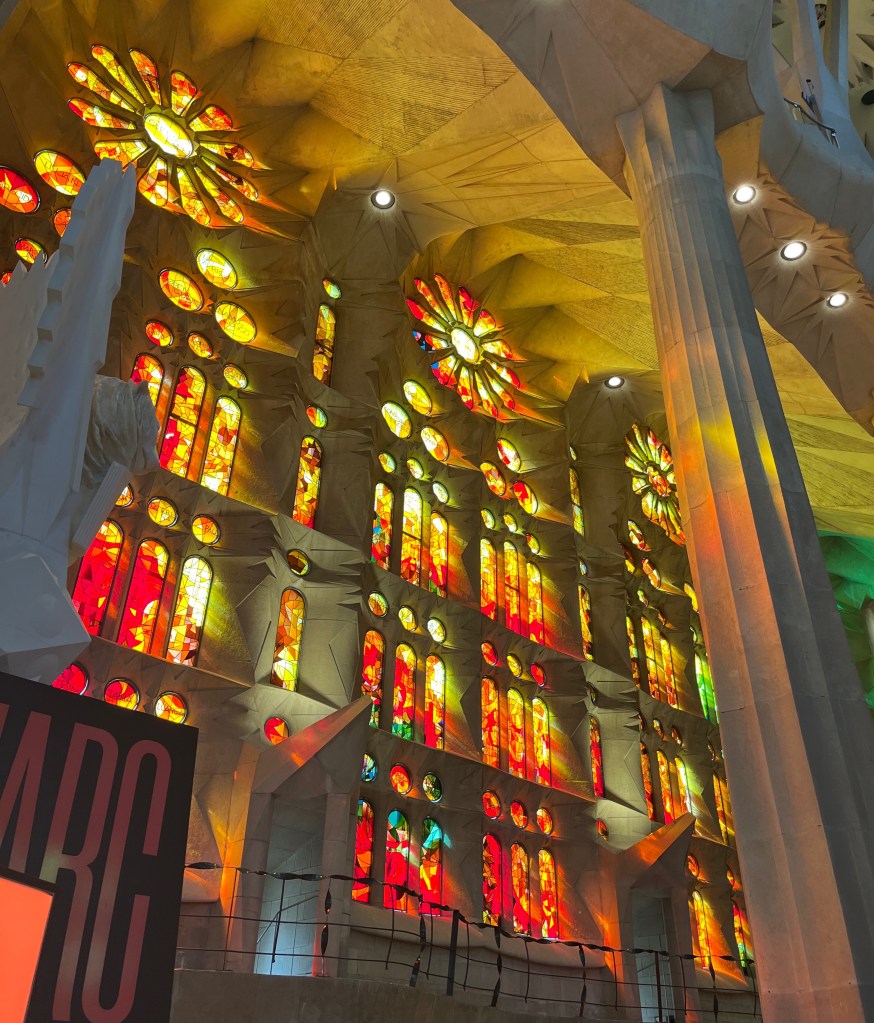
There is no music playing in the cathedral but the light sings, rising to a glorious crescendo like Handel’s Hallelujah Chorus, worship without words.
Gaudi never lived to see his masterpiece finished, dying in 1926, but he left his designs behind for others. Construction is still underway and the goal for completion is 2030. Each time a section is completed Barcelona has a celebration. What a party it will be when Sagrada Familia is finally complete.
I take 100 pictures, maybe more, to share and replay my day to Steve as much as possible.
We get through our last night in Barcelona and I’m still well.
At 3:30 AM a taxi picks us up for the airport. Our Mediterranean odyssey is over. Small groups of young people walk and talk, smoke and drink, congregate along Las Ramblas. Barcelona never sleeps.

 Belonging
I read every word and felt I was right there with you for every place you visited. Had no idea your writings were so impactful and vividZ
LikeLike
Thanks Penny! We MUST travel together sometime, right!
LikeLike
I love the way you write cousin. You have a true gift of drawing the reader into the world that you’ve experienced on your vacation! Bravo!
LikeLiked by 1 person